

The Strategic Operator: How to Kill the “Complexity Tax” Before You Hire a COO
- Bronwyn Erasmus
- Jan 9
- 3 min read

Most organizational chaos isn’t a people problem—it’s a System Debt problem.
There’s a familiar moment in a growing company where everything still works, but the cost of working has become unsustainable. Slack is busy. Calendars are full. Decisions feel harder than they should.
The founder is underwater. Decisions are logjammed. Priorities collide. In the thick of it, it’s easy to look at the friction and think, “I have a people problem.”
You assume you need a heavy-hitting COO to come in and "professionalize" the team.
But here is the hard truth:
Hiring a COO into a broken system is the most expensive mistake a growth-stage company can make.
Doing so prematurely is just funding a Complexity Tax.
In my experience, most organizational friction isn’t personal — it’s structural.
What is a Complexity Tax?
When you were 10 people, you moved fast because of osmosis. At 50 or 100 people, osmosis fails. Without a formal operating model, you begin paying an invisible tax—a drag that eats 20–30% of your team’s output.
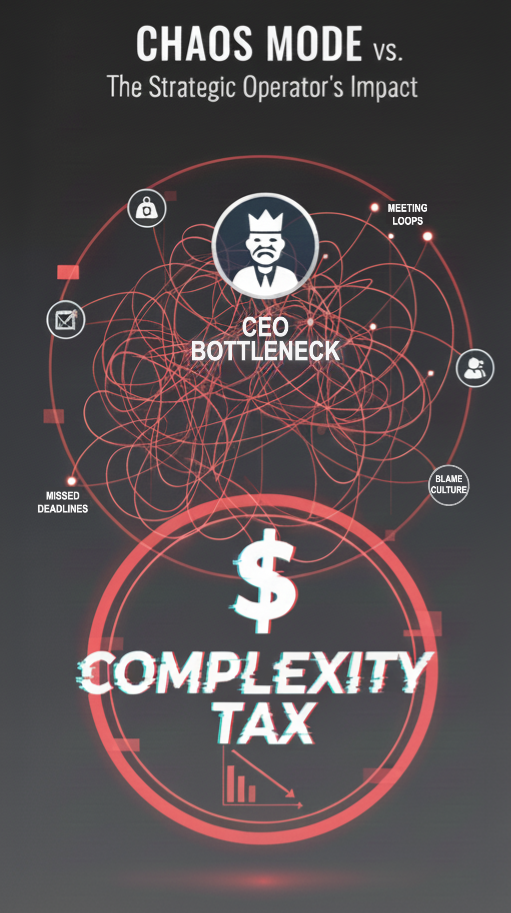
You are paying this tax when:
Decisions are structurally centralized:
80% of decisions funnel to one person (or a select few) who lack the ground-level context to make them quickly.
KPI friction exists:
Marketing is incentivized for lead volume, Sales for deal quality, Operations for cost reduction. They aren't collaborating; they’re competing.
The "meeting loop" takes over:
Meetings exist to plan more meetings, or to discuss why the last ones didn't result in action.
Heroism becomes the standard:
You rely on "rockstars" staying late to fix gaps a system should have caught.
When you’re paying this tax, your people aren't failing—they're suffocating under the weight of System Debt.
THE "EARLY COO" TRAP
A COO’s job is to scale a machine that already exists.
If you hire a COO before you have a functional operating model, they spend their first six months in Triage Mode.
They inherit ambiguity, not authority:
Without a defined system, they referee "he-said, she-said" turf wars.
They build process for process’s sake:
To justify their seat, heavy layers appear—killing the agility that made you successful.
Executive drift sets in:
The CEO and COO clash over decision rights because the rules were never codified.
A COO should never be hired to create clarity.
They should be hired to scale it.
The Scale Test

Walk onto your floor (or into Slack) and ask three random employees:
Exactly how do we make money?
How does your specific work today impact that?
How do you know if you are winning or losing this week?
If you get three different answers to the first — or crickets on the second or third — you don't have a leadership problem.
You have a System Debt problem.
Enter the Strategic Operator: The Architect of Execution

Before you hire the “Captain” (the COO), you need the Architect.
A Strategic Operator installs the Minimum Viable System required for autonomous growth. They don’t just manage — they engineer the engine room:
Vision Translation:
Turning a three-year North Star into 90-day sequencing so teams know exactly what to ignore.
Decision Rights Architecture:
Codifying ownership so decisions stop climbing to the CEO's inbox.
Cross-Functional Alignment:
Rewriting KPIs so "winning" means the same thing across Product, Revenue, and Operations.
Operational Rhythms:
Replacing status updates with high-velocity, blocker-removal cadences.
The ROI of Scaffolding
A Strategic Operator builds the scaffolding that supports the weight of your growth. Once the system is in place:
The CEO gets their genius zone back. Decisions become faster and less emotional.
The COO hire is de-risked. You hand them a machine they can actually drive.
Execution becomes inevitable. Progress is no longer tied to heroic efforts, but to a repeatable rhythm.
Chaos isn’t a signal that your team can’t scale.
It’s a signal that your system hasn’t caught up to your ambition yet.
Before you add another executive seat, ask yourself:
What decisions should no longer require one?


Comments